|
Koch Emails
July 31, 2015 at 10:48 am
A front-page Times news article about the Koch brothers reports, "Relations with the news media could be fractious: If Koch Industries did not like an article, its public-relations team was in the habit of posting email exchanges it had with the reporter."
My goodness, posting a reporter's emails! What a hardball tactic! This from a newspaper that has in recent weeks published articles on emails between Michael Lynton and Henry Louis Gates Jr., and on the electronic job application to the Obama campaign of a Washington Post reporter who is imprisoned in Iran. At least Koch is publishing emails that were voluntarily addressed to Koch; the Times is publishing other people's correspondence that was unlawfully or brutally obtained. It's a double standard by which the Times takes the privacy of others lightly while objecting to transparency when it is applied to the newsgathering process.
Times Uses PETA Donor to Cover Zoo
July 30, 2015 at 12:02 pm
Retraction Watch has a piece by Times journalist Tracy Tullis, who reports that she told her Times editor she was a donor to People for Ethical Treatment of Animals before she was assigned an article about an elephant at the Bronx Zoo:
I also told him that I'd made small contributions over the years to various animal welfare organizations, including PETA, which is mentioned in the article. The ethics handbook cautions writers about financial donations too, but Ferguson didn't respond to that part of my email, which I assumed meant it wasn't an issue.
Inexplicable
July 29, 2015 at 1:39 pm
Andrew Ross Sorkin has a column about Hillary Clinton's plan to raise capital gains taxes.
He writes: "Individuals in the top bracket would pay ordinary income tax on the sale of investments — 39.6 percent — in the first two years and "then the rate would decrease each year" over the next four years until it returns to the current capital gains rate of 20 percent." That "20 percent" description understates the current top capital gains rate, which the Times has elsewhere (for example, here, here, and here) more accurately described as 23.8%. (A 3.8 percentage point Medicare tax is added to the 20%, and in some places, state and local income tax also applies).
The column by Mr. Sorkin goes on:
Curiously, Mrs. Clinton says the new tax structure would apply only to the nation's wealthiest in the top tax bracket. (Why she wants to give incentives to the richest to make long-term investments and those with less wealth to be able to day-trade without any disincentive is inexplicable.)
It's not "inexplicable," it's totally understandable, if one grasps that Mrs. Clinton's purpose isn't to raise revenue for the government or even to weigh in on long-term versus short-term, but simply to join in the fight against "inequality" by punishing people who are doing well financially. She's not trying to help rich people by giving them better incentives to take a long-term approach. She's trying to hurt them by raising their taxes (there are few enough of them that it won't appreciably hurt her chances of getting elected). If she started raising taxes on less wealthy people, it could hurt her more politically, because those are the people who are more inclined to vote for her.
Maybe Mr. Sorkin is being arch here and I am just missing it.
Samuel Pisar
July 29, 2015 at 1:28 pm
The Times obituary of Samuel Pisar z'l strangely omits any reference to his role as the longtime lawyer of Robert Maxwell, which is in the Times clips.
Nails Rebuttal
July 29, 2015 at 1:25 pm
The Times has published an official response to the criticism of its nail-salon investigation.
Jason Rezaian's Computer
July 29, 2015 at 1:18 pm
The thuggish Iranian government seized the computer of Washington Post reporter Jason Rezaian and has thrown him in jail for more than a year. The New York Times apparently sees this as justification to print anonymous quotes from people describing Mr. Rezaian as a biased journalist, and disclosing the contents of the computer:
"For Jason, Iran was not just news; it was part of his personal story and emotions," one friend said. "He saw himself as someone who could play a constructive role in bringing Iran and the U.S. closer."
In 2008, without a full-time job in Iran, he completed an email form offering help as an Iran expert to Barack Obama's election team, a friend said. He never deleted the email from his computer, and it became part of the accusations against him, the Iranian news media has reported.
How many New York Times reporters once applied for jobs or sent emails "offering help" to politicians or partisan causes? Is the Times going to disclose all of them, too?
I'm all for trying to get Mr. Rezaian free, but something about the Times approach here makes me uncomfortable.
Minimum Wage Experts
July 27, 2015 at 11:15 am
Smartertimes reader-participant-watchdog-community-member-content-co-creator Colin writes:
Not sure if you saw today's NYT piece on the minimum wage but it's a real piece of work. The only three experts quoted in the article on this contentious topic are Jared Bernstein, someone from the left-wing Economic Policy Institute and the national director of the lefty Working Families Party. The ideologies of both the EPI and WFP are unmentioned, while the WFP official is allowed to use his quote in the story's conclusion to editorialize rather than provide any analysis about the economic impact of a minimum wage hike. The only skeptic of minimum wage hikes even named in the piece is David Neumark, who is seemingly only mentioned to introduce the concept on an increase in the earned income tax credit.
One can't help but wonder whether journalist Noam Scheiber doesn't know any right-of-center economists worth quoting on the topic or simply doesn't find their views relevant or worthwhile. Neither explanation is reassuring.
Furthermore, the only two business people quoted in the piece are a guy who already pays his workers above minimum wage and is thus largely unaffected and someone who owned a Subway franchise until selling it a couple of months ago. Quotes from the former franchise owner, meanwhile, appear to confuse the issue:
Wanda Austin-Peters, who owned a Subway franchise in Albany for 10 years until she sold it in May, said labor normally accounted for 50 percent or more of her costs in a given year — relatively high compared with an industry average of around one-third. She added that she had little ability to raise prices.
"It would be stupid to charge $7 for a footlong sandwich that everyone else has for $5," Ms. Austin-Peters said. "There's a Subway cropping up in every corner."
The typical reader may be forgiven for thinking that this means a wage increase will not result in higher prices due to competition, but it's difficult to see this dynamic holding when all of her competitors suddenly see their wage costs double (assuming staff and hours worked are not reduced). The relevance of her statement in the context of a massive minimum wage increase is at best unclear.
Conservative Catholics
July 27, 2015 at 10:57 am
A Times news article under the headline "Boy Scouts Are Poised to End Ban on Gay Leaders" reports, "To gain the acquiescence of conservative religious groups that sponsor many packs and troops, like the Mormon and Roman Catholic Churches, the policy will allow church-run units to pick leaders who agree with their moral precepts."
So to the New York Times the Roman Catholic Church amounts to a "conservative religious group." Have the newspaper's reporters and editors been following their own coverage about Pope Francis's campaign against global warming and income inequality, about his assistance in the reconciliation between the governments of the United States and Communist Cuba, about the church's opposition to the death penalty, its support for the labor movement, its advocacy of comprehensive immigration reform and its support for welfare spending?
A reference to "the National Jewish Committee on Scouting" appears in the article without any sweeping statements about Jewish political liberalism or conservatism. This is one of those cases where the Times is so biased that it's comical. Whenever reporters and editors feel the need to slap the "conservative" political label on a think tank, a church, or an an organization, they'd be better off stopping, taking a deep breath, and asking themselves: is this group really "conservative" by the standards of the rest of America, or just by the standards of the Upper West Side (or brownstone Brooklyn, or Montclair, N.J.) liberals in the New York Times newsroom? And if they really are "conservative," is the label necessary, or can Times readers figure it out for themselves? And if the label is really necessary, are the liberal groups in the story labeled the same way? It drives me nuts!
What the Times Got Wrong About Nail Salons
July 26, 2015 at 9:39 am
Former Times reporter Richard Bernstein, a part owner of two day-spas in Manhattan, has a devastating post up at the New York Review of Books thoroughly debunking — or at the very least credibly challenging — that big New York Times investigative series of the city's nail salons. Mr. Bernstein, calls the Times coverage "demonstrably misleading." Particularly interesting are Mr. Bernstein's thoughts about why the Times got it wrong:
The narrative chosen by the Times, what might be called the narrative of wholesale injustice, is one of the most powerful and tempting in journalism. Certainly, as Mr. Baquet put it, it had "impact." It was read, he told an audience in mid-June, by 5 million people, which is five times the readership of the Sunday print edition, and produced an immediate government response.
But the quest for impact can overwhelm a newspaper's primary responsibility for accuracy. If the Times had revealed that undocumented workers in the salon business are being subject to abusive treatment, it would have served a useful and important purpose. But in extrapolating from the experience of Ms. Ren to make assertions about that "vast majority," the paper has put its tremendous prestige and power behind a demonstrably misleading depiction of the nail salon business as a whole.
Angry Obama
July 22, 2015 at 10:31 am
A dispatch from Pittsburgh reports that President Obama "called angrily for Iran to release Americans who are being held prisoner there."
How does the Times know whether Mr. Obama is genuinely angry or just feigning anger? I'd prefer if the Times limited itself to describing what a reporter can see or hear — a politician raising his voice, pounding the podium, clenching his jaw, uttering profanities, or getting red in the face — rather than making assumptions or drawing conclusions about the politician's underlying emotional state of mind. They are all pretty good actors or they wouldn't have gotten to that level.
And that's not even getting into the question of racial stereotypes that describing Mr. Obama as "angry" might raise.
Context Or Opinion
July 22, 2015 at 10:23 am
A dispatch from Tehran reports, "The agreement will end punitive sanctions imposed on Iran by the United Nations, United States and European Union in exchange for verifiable guarantees that the Iranian nuclear program remains peaceful."
That's supposed to be neutral background context, but in fact, as other, better Times coverage indicates, it's a tendentious description. There's a lively dispute over whether the Iranian guarantees — promises is another way to describe them — are indeed "verifiable." For example, a Times dispatch from Washington begins, "The Obama administration's claim that the Iran nuclear accord provides for airtight verification procedures is coming under challenge from nuclear experts with long experience in monitoring Tehran's program." Future Times coverage should avoid describing Iranian promises as "verifiable guarantees," or at least attribute the description to advocates of the deal rather than repeating it, unattributed, as if it were uncontested fact.
Muslims and Chattanooga
July 19, 2015 at 10:20 pm
Smartertimes reader-participant-watchdog-content co-creator-community member Colin G. writes:
Following the shooting in Tennessee it seems the NYT has identified the real victims -- the local Muslim population:
http://www.nytimes.com/2015/07/18/us/at-chattanooga-mosque-grief-mixes-with-fear-of-revenge.html?ref=todayspaper&_r=0
Maybe it's just me being overly cynical, but is this not the world's most predictable spin?Can you imagine the paper running a similar story about a backlash against those who display the Confederate flag?
And of course I say this as someone with absolutely nothing against Muslims and who personally finds the Confederate flag an anachronism at best and odious at worst.
Hard Right Walker
July 19, 2015 at 10:10 pm
A Times news article asserts, "Scott Walker wants to come across as the most electable of the hard-right conservatives in the race." David Bernstein writes that in the entire history of the Times, it's used the phrase "hard left liberals" exactly once, in 1998, in reference to the New Mexico Green Party, and never with respect to Democrats.
Druggies Overrun a Manhattan McDonald's
July 19, 2015 at 9:55 pm
The Times carries a breathtaking dispatch about a McDonald's in Midtown Manhattan that has been overrun by lawless and sometimes violent drug addicts. "Nobody from this McDonald's, or the corporate office, responded to requests for comment," the Times reports.
There's no indication that the Times sought comment from the office of Mayor de Blasio, who is, you know, responsible for quality of life and law enforcement in the city. Or that the paper sought comment from the police department, or from the district attorney for New York County. In fact the name of Mayor de Blasio, who has been associated in other newspapers, such as the New York Post, with a decline in the city's public order and quality of life, is nowhere to be found in the Times dispatch. It seems a strange blind spot.
One Times staffer tweeted that "that McDonald's has been this way for a long time—It didn't develop these problems with the new administration." If so, why is the Times only writing about it now? And why not explain that to readers of the article in the article, rather than in Twitter. There are probably plenty of Times readers who aren't frequent enough visitors to that McDonald's — maybe even to any McDonald's — to know how long the problem has been there.
The Times Yalta Flip-Flop and Iran
July 15, 2015 at 12:49 am
It's taken 70 years, but the New York Times has finally seen the light on the matter of Yalta.
Or at least the editor of its editorial page has. That's what I gather from a post by Andrew Rosenthal at "Taking Note," the blog of the Times editorial page. As part of a long list of "most destructive foreign policy decisions," Mr. Rosenthal lists "the decision to carve up Europe with Stalin, creating the Soviet bloc, sparking a nuclear arms race and leaving entire nations in bondage to the Kremlin for a half century."
It's terrific that the senior editorial leadership of the Times has come around to this view of the agreement struck by Roosevelt, Churchill, and Stalin in February of 1945. It's been a long time in coming. In its post-Yalta editorial of February 13, 1945, headlined "For Victory and Peace," the Times pronounced that "the first glance" at the "long and detailed agreements" indicated that they "show the way to an early victory in Europe, to a secure peace, and to a brighter world." The Times editorial described Yalta's resolution of the "troublesome problems represented by the names of Poland and Yugoslavia" as "a compromise that will have to be accepted on all sides as the best that can be obtained in the present troubled world."
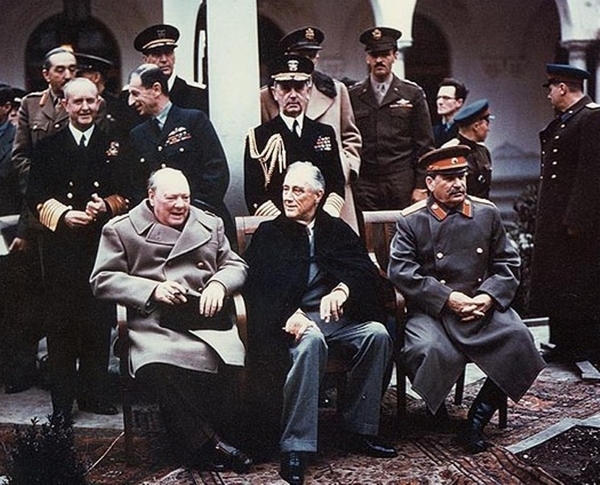
A year later, in a February 12, 1946 editorial headlined "The Yalta Bargain," the Times backed away, but just slightly: "Probably it will not be until many years have passed, when the events of 1945 can be viewed from a better perspective than is now possible, that an objective appraisal can be made. Right now many will say the Soviet received a great deal for the promise of very little."
Even as recently as 2005, when President George W. Bush criticized Yalta, the news columns of the Times were trotting out left-wing historians to condemn him. From that 2005 Times article:
Robert Dallek, a Boston University historian and an expert on Roosevelt's foreign policy, agreed. "Republicans have been beating on this issue since the end of the Roosevelt presidency, and they have been consistently off the mark," he said. "This idea that Roosevelt and Churchill gave away Eastern Europe to the Soviets is nonsense."
David M. Kennedy, a Stanford historian, put it this way: "This was a stick to beat the Democrats up with in the McCarthy era."
It would be nice if the Times made the acknowledgement of its Yalta error in print and in the editorial column rather than just in a blog posting by the editorial page editor, but the blog post may be, well, "the best that can be obtained in the present troubled world."
While acknowledging a past error, the Times seems bent on committing a new one, issuing an editorial hailing the agreement on Iran's nuclear weapons. There are certain parallels between Yalta and this Iran deal — carving up the Middle East with Iran the same way Roosevelt split Europe with Stalin, consigning Iranians to bondage, the talk of the best available compromise, the war-weariness. This deal, too, meets with initial praise from the Times. One hopes it will take less than 70 years before some editor realizes that the New York Times got this one wrong, too.
<- Prev 15 items | Next 15 items ->
|
|



