|
The Times' Farewell to Bloomberg
December 29, 2013 at 10:19 pm
It's interesting to think of the Times editorial on 12 years of Mayor Bloomberg in the context of all the talk about the possibility that Mr. Bloomberg might purchase the Times. The Times writes that "in perhaps his worst mistake — authorizing a police practice found unconstitutional by a federal court — Mr. Bloomberg and Police Commissioner Raymond Kelly humiliated and alienated black and Hispanic communities by having stop-and-frisk turn into a generalized method of harassing law-abiding citizens." It ignores Mr. Bloomberg's accomplishments in fighting terrorism and says of Mr. Bloomberg, "his unscripted comments, especially about the poor, can range from thoughtless to heartless."
Is the Times' goal to annoy the mayor to the point where he decides to use his billions to buy the paper and replace the current Times team of editorial writers with the Bloomberg View crew, a number of whom are themselves veterans of the Times editorial page? If so, it's a risky maneuver, because Mr. Bloomberg may just as easily decide that he doesn't want to deposit a fraction of his billions in the pocket of the Ochs-Sulzberger family as a reward for calling him, in essence, a heartless racist, and that he'll instead let the Times look elsewhere in its search for a billionaire bailer-outer that would allow the Ochs-Sulzberger family to escape, Graham-style or Taylor-style, with both their capital and their reputation intact.
Three Weeks Late, Couldn't Be More Wrong
December 29, 2013 at 9:56 pm
A Times dispatch headlined "Members of Jewish Student Group Test Permissible DIscussion on Israel" has drawn the following response from the president and CEO of Hillel, Eric Fingerhut:
On Sunday, December 29, The New York Times published an article regarding the "Open Hillel" vote, which took place three weeks ago at Swarthmore College. It is teased on the front page and appears on page 21 of the A-section; it is also available online. As you know, there have been many articles on this topic, and we expect more. Although this article has been in the works for weeks, the Times does little more than repeat claims made in other publications by a handful of students. Instead of seizing the opportunity to look deeply into this issue, the Times took the easy way and turned its story into a simplistic discussion of free speech on campus and conflict among millennial Jews and their elders.
This article couldn't be more wrong.
I spoke to the reporter for nearly an hour. David Eden also spoke with her several times. As you can see, we both are briefly quoted in comparison to the few students who are showcased. Information was sent refuting the alleged Harvard incident, the Swarthmore vote (including that only seven out of a 14-member student board voted "unanimously"), and the alleged Binghamton College incident (which was noted).
This article took the position that Hillel "whose core mission is to keep the next generation of Jews in the fold, says that under its auspices one thing is not open to debate: Those who reject or repudiate Israel have no place." Hillel has never said any such thing, and the Times knows it.
First, Hillel's "core mission," clearly expressed on our website and repeated to the Times reporter several times, is to build an enduring commitment to Jewish life, learning and Israel. We are pursuing this mission vigorously every day. More importantly, our guidelines on Israel refer explicitly to rejecting partnerships with organizations and speakers that seek to harm or destroy Israel. Nowhere does Hillel declare that any Jewish student has "no place" at Hillel, nor would I or anyone associated with Hillel International say such a thing.
As we have said many times, Hillel welcomes all students, Jewish and non-Jewish, to discuss and debate topics that are sensitive on many topics, including Israel. We welcome students who have a diverse range of political views and who may be aligned with a broad range of political organizations to talk about a wide variety of issues. We are an open, accepting, educational, humanistic organization, and any suggestion to the contrary is false and a disservice to the student and professional leaders that make Hillel such a special place on 550 campuses across five continents.
The Times reported that a "nationwide online petition in support of the Swarthmore Hillel's rejection of [the Hillel Israel] guidelines has gathered 1,200 signatures." It was pointed out to the reporter that there are approximately 400,000 Jewish students on American college campuses, nearly 20 million college students overall, and that a thousand or so names, many from non-students or signed "anonymous," was not a large number. That fact was ignored. When it was pointed out that there is no groundswell of support for "Open Hillel," it was brushed aside and not included.
Where Hillel draws the line, and what we have said consistently, as reported in the Times and elsewhere, is that "'anti-Zionists' will not be permitted to speak using the Hillel name or under the Hillel roof, under any circum- stances." The Times also noted our Israel guidelines that spell out that Hillel "will not host or work with speakers or groups that deny the right of Israel to exist; "delegitimize, demonize or apply a double standard to Israel"; support boycotts, divestment or sanctions against Israel; or "foster an atmosphere of incivility."
This is hardly a policy of censorship or free speech. As Alan M. Dershowitz said to the Times: "I don't think this is a free-speech issue. The people who want divestment and boycotts have plenty of opportunity to speak on campus. The question is a branding one. You can see why Hillel does not want its brand to be diluted."
In 2010, Hillel developed its Israel guidelines precisely because every responsible organization needs to establish certain rules. Ours, created with a wide group of stakeholders, are appropriate and we intend to maintain them. I was quoted correctly in the Times saying, "If we're an organization that is committed to building Jewish identity and lifelong connections to the Jewish world and to Israel, then we certainly have to draw lines."
We have drawn that line. We are unwavering.
Hillel will continue to reach out to all college students who have questions about Israel. Some have deeply held disagreements with Israel's policies and still consider themselves Zionists. Others mistake their deeply held disagreements with the policies of the Israeli government as anti-Zionism, while others are swept up in the anti- Zionism of friends or faculty, or simply in the passion of being young and on campus. With all students, our profes- sional and student leaders will work heartily to provide knowledge and build trust. But there are some who are simply not interested in any such thing. We will still welcome them as students for Shabbat dinner and other events, but we cannot and will not let them guide our programming.
Hillel loves Eretz Israel because it is part of our Jewish identity. It is our job, together with other Jewish organizations and leaders, to encourage Jewish college students to embrace this love of Jewish life, learning and Israel as part of the character and self-identities they are building while in college. We will continue to take all necessary steps to support and promote this mission.
Unregulated Liver Injuries
December 23, 2013 at 9:31 am
A front-page news article in Sunday's New York Times blames what a photo caption calls "largely unregulated" dietary supplements for a spike in liver injuries. From the article: "unlike prescription drugs, which are tightly regulated, dietary supplements typically carry no information about side effects."
The implicit argument is for increased regulation of the dietary supplements to prevent the liver injuries.
The article reports, "Dietary supplements account for nearly 20 percent of drug-related liver injuries that turn up in hospitals, up from 7 percent a decade ago, according to an analysis by a national network of liver specialists."
But it never says what accounts for the other 80 percent. Highly regulated prescription drugs? Nor does the article mention all the liver disease caused by highly regulated alcoholic beverages — in fact, the writer of the Times article, Anahad O'Connor, is running around elsewhere promoting his own book by granting interviews to bloggers in which he says, "no great meal is complete without a perfectly paired wine. Barbarescos, Barolos—anything from the nebbiolo grape—and cabernet francs are my favorite."
There's just not much evidence for the unstated assumption in the Times article, which is that additional regulation would decrease the injuries.
Health Law Waiver
December 20, 2013 at 9:26 am
The Times has a front-page news article about the Obama administration's decision to allow individuals facing cancellation of their health insurance to buy catastrophic policies that don't meet ObamaCare standards and to avoid any penalties for being uninsured in 2014.
It would have been a better story if it explained where the administration gets the legal authority to make this change. Otherwise, it looks like just the latest example of what Christopher Demuth described in the Weekly Standard recently:
Obamacare is introducing a new form of government—improvisational government, characterized by continuous ad hoc revisions of statutory law by executive decree. This is a reversion to a primitive form that long antedates our Constitution and rule-of-law traditions. Transported to the modern world, it leaves the private sector in a state of constant uncertainty and subjection.
Food Stamp Fraud
December 19, 2013 at 12:33 pm
The national section of the Times carries a news article about food stamp fraud. It's nice to see the Times tackle this subject, but from the article, it's hard to avoid the conclusion that the reporter or editors involved in carrying out the assignment did so with considerable reluctance.
The Times reports: "In fact, the black market accounts for just over 1 percent of the total food stamp program, which is far less than fraud in other government programs like Medicare and Medicaid."
Lower down in the article, the Times concedes, "Include erroneous payments to recipients because of errors on the part of the government or outright lying on applications, and the overall loss to the food stamp program is about 4.7 percent, according to the Department of Agriculture."
Well, why wouldn't one include "outright lying on applications" as part of an estimate of fraud?
The Times then rushes, defensively, to minimize the problem, "Although the sheer size of the program means that more than $3 billion is lost to trafficking, fraud and overpayments each year, the rate is less than other government programs, according to federal audits."
I don't trust these audits to accurately measure the amount of fraud in the program. Isn't it possible that some fraud escapes the notice of the auditors? The Times doesn't seem to have considered the possibility.
The Times article ends like this:
At a video game and computer repair shop next door, customers said that the E.B.T. black market was nothing new and that it still thrived.
"Most of the people I know use food stamps, but 90 percent of the people who are on food stamps need them," said Reginald Davis, the owner of the store.
The bigger issue, he said, is why poor people are being targeted at all.
"They make a bigger deal of people trying to sell $200 worth of food stamps than they do over a banker who steals $10 million," he said. "You come out here and look around and then tell me you're going to sweat someone for that. People here got nothing."
Leaving this as the closing thought of the article conveys the impression that Times editors or the reporter agree with it, and can't wait to get away from this food stamp fraud topic and go back to writing about evil bankers.
Only a Few Years
December 19, 2013 at 10:44 am
A Times account of the conviction of Michael Steinberg as part of the federal investigation into insider trading at the hedge fund SAC Capital reports, "Mr. Steinberg faces a maximum of 85 years in prison, but will almost certainly receive a sentence of only a few years."
"Only" a few years? It sounds as if the Times is making light of it. "A few years" in prison can be a long time for the prisoner or his family and is a lot more than the usual civil penalty of fines, disgorgement, and a temporary or lifetime ban from the securities industry that is assessed in other securities fraud cases.
Liptak's Trick
December 17, 2013 at 10:53 am
Judge Jed Rakoff's discussion of why prosecutors have avoided criminal charges against those responsible for the financial crisis is the topic of a news article in today's Times by Adam Liptak. Mr. Liptak frames the story as follows:
Judge Jed S. Rakoff wants to know why. In a blistering essay in the issue of The New York Review of Books that arrives this week, he argues that the Justice Department has failed in its rudimentary responsibilities, offering excuses instead of action.
That makes it seem like the Times is ahead of the story, or at least on top of it — "arrives this week."
In fact the Rakoff story was covered on the Web site FutureOfCapitalism.com back on December 6, on the basis of an article the judge posted November 15 on a Columbia Law School blog. Mr. Liptak does not mention either the FutureOfCapitalism post or the Columbia Law School blog post. It's a small point, but the effect is to make it look like the Times is ahead of the news rather than behind it.
Rothstein on the National Archives
December 17, 2013 at 10:49 am
One of the bright spots in the Times is Edward Rothstein, who does a fine job of criticizing a new exhibit at the National Archives for being too critical of America. I don't know how he manages to get this stuff in the paper, but he does, and I enjoy reading it.
Orin Kerr Says He Was Misrepresented
December 17, 2013 at 9:49 am
A professor at George Washington University law school, Orin Kerr, says the Times mischaracterized both his position and his remark about Judge Leon. Professor Kerr writes on the Volokh Conspiracy web site:
A New York Times story out on Judge Leon has me quoted as saying:
"He's very passionate," said Orin S. Kerr, a professor at the George Washington University Law School and a defender of the N.S.A.'s surveillance programs, who said he found the judge's ruling short "on legal reasoning."
Just to be clear, I told the reporter that this specific opinion was passionate, not that Judge Leon is passionate. The reporter specifically asked me if I thought Judge Leon was passionate, and I declined to answer on the ground that I didn't know Judge Leon or his decisions well enough to feel comfortable characterizing him or his work as a whole.
Second, I am not a defender of the NSA's surveillance program. Contrary to the reporter's characterization, I think this program violates the FISA statute. I just happen to think that the program is consistent with existing Fourth Amendment precedent; it is fine under the Constitution but is hard to square with the statutory text.
Thanks to reader-participant-community member-watchdog-content co-creator J. for sending the tip.
Bad Moments in Photo Selection
December 17, 2013 at 9:39 am
"Top Candidate for a Post at Europe's Central Bank Is a Woman" is the headline the Times business section runs over an article by Jack Ewing, the male Times reporter last seen airbrushing the Faber-Castell company's World War II history. 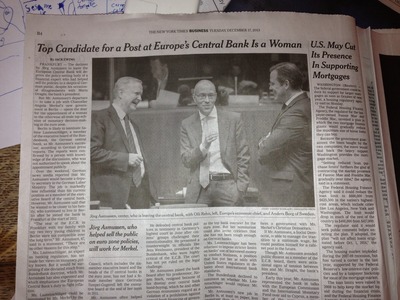
Leaving aside the totally pertinent question of whether Sabine Lautenschlager's gender is the most newsorthy thing about her, one has to wonder about the decision to illustrate an article with that headline with a photograph of three men. The Times Web site does have a photo of her, if you are curious.
Battling Homelessness in NYC
December 16, 2013 at 6:16 am
The Times editorial about its five-part series on Dasani, a poor child who lived for three years with her two parents and seven siblings in one room of a fetid Brooklyn homeless shelter, offers a narrow view of possible solutions: "rental subsidies." The editorial concludes, "That's a good start, but more is needed, including from Gov. Andrew Cuomo, who can aid that effort by ponying up money for the subsidy program as well as for services that save poor people from eviction."
The editorial makes it sound as though Mr. Cuomo will be "ponying up money" out of his own pocket, rather than by taxing New Yorkers who already live in one of the highest-tax states in the nation (first or third, depending on how you count). Some of those New Yorkers have made different choices than Dasani's parents. They may have chosen to have fewer children than eight, or to avoid using illegal drugs, or to move out of New York City to areas where housing costs are lower, such as upstate. The editorial doesn't make the case for the justice of taxing a hardworking, law-abiding New York family of four who moves out of the city to afford an unsubsidized rent so that Dasani's non-working, drug-addicted parents can remain in New York City in an apartment that can accommodate their family of eight.
What's more, the editorial is missing a sense of the economy of the New York housing market. Wouldn't more, and more generous rental subsidies just lead landlords to raise rents by the amount of the subsidy, the way colleges do with Pell Grants? Or wouldn't the introduction of additional rental subsidies deny apartments to the New Yorkers who otherwise would have rented the apartments on a market basis but will now be displaced or outbid by the subsidy recipients? It's not, after all, as if there are tens of thousands of rental apartments sitting vacant in New York just waiting for a family to come along who can afford the rent. Family-sized apartments in New York are a relatively scarce commodity.
Absent from the Times editorial is any sort of supply-side sense that an improvement in the situation requires more apartments, not just more rent money, some of it in the form of subsidies supplied by taxpayers, chasing the existing pool of apartments. Asking "how do you get more apartments" would involve looking at things like zoning regulations that render areas of New York City far less dense than they could be or reserve them for industry rather than housing, landmarked historic districts that block new construction, environmental regulations, politicized land-use approval processes, the role of unions in driving up construction costs, a city building department with regulations so Byzantine that you basically have to hire an "expediter" to deal with it, and so forth.
Finally, interpreting the whole situation as one about housing or homelessness, one that can be solved with a rent subsidy or services that prevent eviction, also seems to avoid the much more complex issues that made Dasani's story so heart-wrenching and compelling. How do you break cycles of drug addiction and violence and crime and poverty that run through multiple generations of a family? One child that Dasani is seen fighting with in the series apparently lives in a housing project. She's not homeless like Dasani, but she doesn't seem headed for much more happiness in life, which seems to undercut the Times' assumption that the problems described in the series are susceptible to being solved solely by an increase in rent subsidies.
Tobacco and Poorer Nations
December 13, 2013 at 8:38 am
The Times takes its inequality campaign to the campaign for increased regulation of tobacco. From a front-page news article that runs under the headline "Tobacco Firms' Tactics Limit Poorer Nations' Smoking Laws": "tobacco opponents say the strategy is intimidating low- and middle-income countries from tackling one of the gravest health threats facing them: smoking."
What "poorer nations" is the Times talking about?
From the article:
Dr. Margaret Chan, director general of the W.H.O., said in a speech last year that legal actions against Uruguay, Norway and Australia were "deliberately designed to instill fear" in countries trying to reduce smoking.
Norway and Australia aren't exactly low-income or poor countries. The Times summons up a few others — Namibia, Gabon, Togo, and Uganda. It reports:
Uruguay has acknowledged that it would have had to drop its tobacco control law and settle with Philip Morris International if the foundation of the departing mayor of New York, Michael R. Bloomberg, had not paid to defend the law. (The company's net revenue last year was $77 billion, substantially more than Uruguay's gross domestic product.)
In fact Yahoo! Finance lists the trailing twelve months revenue for Philip Morris International as $31.32 billion, and the CIA World Factbook lists Uruguay's 2012 GDP as either $54.67 billion or $49.4 billion, so the Times claim that PMI's revenue was "substantially more" than the GDP of Uruguay appears to be incorrect. Here is the PMI 2012 earnings press release reporting net revenues of $31.4 billion. (The difference between $31 billion and $77 billion may have to do with accounting for excise taxes.)
But the relevant comparison isn't really to PMI's worldwide revenues but rather to whatever business the company does in Uruguay, which is what the company would probably be thinking of when it makes decisions on legal spending related to that market. Uruguay, and even the poorest sovereign, has taxing power, an army, along with the power of the anti-tobacco World Health Organization and its allied billionaires such as Michael Bloomberg. Depicting the tobacco companies as the big, well-funded bullies throwing their weight around in this situation may fit into the Times' (and its readers) preconceived notions about evil big business. But it stretches the limits of accurate journalism to depict this, as the Times does, as a situation in which the poor countries are the underdogs against the powerful tobacco companies.
Glass House
December 12, 2013 at 9:15 am
From an article in the Home section of today's Times about a reporter's overnight stay in Philip Johnson's New Canaan, Conn., Glass House: "Tours of the house run from May through November; beginning at 9 in the morning, they end at 5 and typically top out at just over two hours."
That is a sentence that could have benefitted from some editing. If the tours begin at 9 in the morning and end at 5, it sounds like they last eight hours, not two hours. It sounds like what the writer is trying to communicate is that the tours take about two hours and begin on the hour starting at 9 a.m. and ending at 3 p.m. (or something like that).
It's not clear why the Times chose to run this article in December, when the house can't be toured until May. It looks like the place is also open for tours from 5:30 to 8 p.m. on Thursday evenings during that season, so it's not even clear that the Times claim that the tours "end at 5" is even accurate.
What Dasani Needs Most
December 12, 2013 at 9:00 am
From Chapter Four of the five-part series on Dasani, the child who lives with her parents and seven siblings in a fetid Brooklyn homeless shelter:
Three days later, it is raining as the children spill down Sherry's steps. They are hungry and short on sleep. In theory, they are heading to the thing they most need — psychotherapy. Chanel signed them up after learning that she can reap $10 per child in carfare through Medicaid, at a clinic in the Kensington section of Brooklyn.
I don't doubt that these children might benefit from psychotherapy, but is it really "the thing they most need"? I'd argue that, even more than psychotherapy, they need a better place to live. They could also probably use, more than psychotherapy, higher-functioning parents, but that's harder to make happen. Anyway, it's a kind of classic New York Times editor worldview that of all the things that a child like Dasani and her siblings need, 'the thing they most need" is psychotherapy. Sign the kids up for the Times staff health insurance plan!
Mandela Blamed for Inequality
December 10, 2013 at 9:33 am
From an otherwise interesting Andrew Ross Sorkin column about how Nelson Mandela moved toward capitalism:
But for all of Mr. Mandela's embrace of capitalism and free markets, as demonstrated though his policy called GEAR (Growth, Employment and Redistribution), the results raise more questions than answers about its success.
South Africa has certainly grown, but at an annual 3.2 percent clip from 1993 to 2012, far below other emerging countries like China and India. And the gap between the haves and have-nots is now higher than it was when Mr. Mandela became president. Inequality in South Africa is a real and growing issue.
Only when defined in the most narrow economic terms, as the Times, alas, tends to do.
You wonder how the Times would have covered the exodus from Egypt: "True, God parted the Red Sea and brought the Children of Israel out of Egypt. But after slavery ended, the gap between haves and have-nots started to widen and become a real and growing issue..."
If Mencken's definition of Puritanism was "the haunting fear that someone, somewhere may be happy," then the definition of modern New York Times-Bill de Blasio-Barack Obama style liberalism is the haunting fear that someone, somewhere might be earning more money than somebody else.
<- Prev 15 items | Next 15 items ->
|
|



